
 Back to Blog

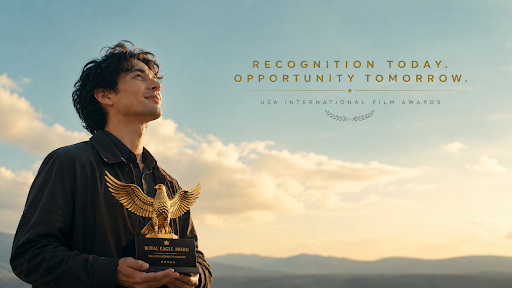
A filmmaker I know once carried a box of festival laurels into a distributor’s meeting.
Not physical trophies.
Just the tiny white festival badges printed across one-sheet.
The distributor glanced at them for perhaps five seconds before asking to watch the trailer.
Five seconds.
That’s all those awards received.
Yet the meeting happened because of those five seconds.
There’s a lesson hidden there that independent filmmakers sometimes miss. Festivals rarely sell your film by themselves. What they do is much harder to measure—and much more valuable.
They persuade someone to press play.
The film business doesn’t reward attention. It rewards trust.
People often describe a festival award as validation. I think that’s only half true.
An international award is really a shortcut for decision-makers.
Distributors receive an overwhelming number of submissions every year. Sales agents do. Streamers certainly do. Nobody has enough hours to watch everything from beginning to end.
So they build filters.
Festival selections.
Awards.
Critical response.
Audience reaction.
IMDb presence.
Those aren’t guarantees of quality.
They’re signals.
And signals matter in crowded markets.
Why laurels still influence business decisions
Independent filmmakers sometimes dismiss laurels as marketing decoration.
I’ve never found that argument convincing.
If two unfamiliar films arrive on a distributor’s desk—both with similar production value—but one has accumulated recognition across respected international festivals, which trailer gets opened first?
Probably the second one.
Not because the laurels prove it’s the better film.
Because someone else has already invested time evaluating it.
That changes perception.
Not permanently.
Just enough to earn another look.
Sometimes that’s the only opportunity a film ever needs.
IMDb isn’t the destination. It’s part of the conversation.
Filmmakers occasionally obsess over IMDb ratings as though a number alone determines a film’s future.
It doesn’t.
IMDb functions more like a living public résumé.
Festival selections, awards, reviews, cast information, production credits—they all contribute to how a project is perceived when someone researches it.
A distributor rarely relies on one metric.
They look at the entire ecosystem surrounding a film.
Recognition from respected international festivals becomes one visible part of that story.
Not the whole story.
But an important chapter.
Distribution begins earlier than most filmmakers think
Many directors imagine distribution begins after post-production.
I’d argue it begins much earlier.
It begins the day you decide where your film will be seen first.
Festival strategy isn’t separate from distribution strategy.
It is a distribution strategy.
Every carefully chosen festival introduces your work to programmers, journalists, fellow filmmakers, sales representatives, distributors, investors, and future collaborators.
Some conversations lead nowhere.
Others quietly reshape careers.
That’s difficult to quantify.
Yet anyone who’s spent enough years around festivals has watched it happen.
The business of festivals is changing and that’s good news for independent cinema
The global film festival ecosystem continues to expand.
Industry forecasts estimate the market at approximately $3.2 billion in 2025, with projections reaching around $5.1 billion by 2034, reflecting steady long-term growth driven by digital participation, hybrid festival models, streaming partnerships, and increasing international access for filmmakers.
What’s interesting isn’t merely the size of the market.
It’s what that growth represents.
Festivals are no longer isolated cultural events serving only local audiences.
Hybrid programming has made it possible for films to reach viewers, industry professionals, and acquisition teams across continents without requiring every participant to be physically present.
That changes opportunity.
Especially for independent filmmakers who may never have had access to traditional distribution networks.
The festival circuit has become less about geography and more about discoverability.
Why international awards have become more commercially relevant
Streaming platforms have altered audience behavior.
They’ve also altered acquisition behavior.
When platforms compete for distinctive stories, discovery becomes increasingly valuable.
Film festivals now occupy an important place in that discovery process.
Not every award leads to distribution.
Of course not.
But recognition often places a film into conversations that might otherwise never happen.
Sometimes an award earns a meeting.
Sometimes it earns press.
Sometimes it earns another festival invitation.
Occasionally it earns all three.
Momentum isn’t created by one victory.
It’s accumulated through many small moments of credibility.
Where the USA International Film Awards fits into that journey
Every festival develops its own identity.
The USA International Film Awards was built around a straightforward idea: exceptional storytelling deserves serious consideration, whether it comes from an established studio or an independent filmmaker working with limited resources.
Recognition here is intended to become more than a certificate or a digital laurel.
It becomes another credible signal in a filmmaker’s professional portfolio one that can strengthen conversations with collaborators, distributors, festival programmers, producers, and audiences as the life of the film continues beyond its premiere.
No responsible festival should promise distribution.
No honest publication should either.
Distribution depends on many variables: the film itself, market timing, audience demand, sales strategy, territory, genre, and countless human decisions.
But awards can change who decides to watch your film in the first place.
That’s a quieter advantage.
And perhaps the more valuable one.
The return on investment isn’t always measured in dollars
Filmmakers often ask whether festival submissions are “worth it.”
The better question is this:
What opportunity disappears because your film was never discovered?
A single festival selection may introduce you to a producer.
A jury member may remember your work years later.
Another filmmaker may become your next collaborator.
A distributor might finally click play.
Those outcomes rarely fit neatly into a spreadsheet.
Yet they’re often the reason independent careers continue.
The trophy eventually gathers dust.
The conversation it starts sometimes doesn’t.
That’s why thoughtful festival strategy has never been about collecting awards.
It’s about creating enough moments where the right person decides your film is worth one more look.


