
 Back to Blog

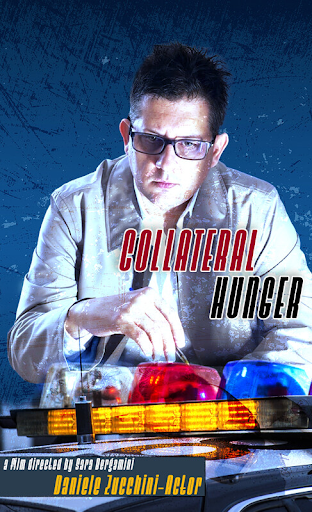
Some films ask audiences to laugh.
Others ask audiences to think.
Collateral Hunger insists on reversing the order.
The recipient of the Royal Feather Award for Best Microfilm, along with Best Actor – Short and Best Producer – Short at the USA International Film Awards, is built on a deceptively simple premise: an inspector, convinced he misses nothing, finally directs his certainty toward the wrong person. It sounds like the setup for a comedy. Instead, it quietly becomes an inquiry into how confidence can disguise uncertainty, and how authority often reveals more about the person exercising it than the person standing before it.
What is remarkable is that the film never arrives at this idea through confrontation. It arrives through restraint.
Listening to director Sara Bergamini, actor Daniele Zucchini, and the producing team together, one discovers that Collateral Hunger was never conceived primarily as a story about crime, policing or institutional authority. Beneath its humor lies something considerably more universal.
Uncertainty.
“Each of us, at least once in our lives, has experienced uncertainty,” Bergamini reflects. “Living day to day is the greatest uncertainty that afflicts so many people… We all need psychological security, which is then reflected in reality.”
That observation quietly reframes the inspector himself.
He isn’t merely someone enforcing rules.
He is someone searching for certainty.
The title, Collateral Hunger, initially suggests violence or consequence, but Bergamini interprets its meaning differently. Asked what is truly “hungry” within the story, she points not toward institutions or conflict, but toward “the human desire to control chaos.”
Chaos, she explains, exists before names, before categories, before certainty itself.
“We need certainties to sleep peacefully… if you build a castle on sand, finally, it collapses.”
That philosophy echoes throughout the film’s construction. Rather than reducing its characters to heroes or fools, Collateral Hunger explores what happens when people cling too tightly to explanations simply because explanations feel safer than ambiguity.
Perhaps this is why the film refuses to embrace conventional crime storytelling.
Bergamini describes its style with an unusual phrase: “psychological comedy.”
The description initially sounds contradictory until she elaborates.
“We want people to laugh,” she says, “but after a few days, we want them to think back with ironic curiosity: What if that had happened to me? How would I have reacted?”
Most comedies measure success by immediate laughter.
Collateral Hunger appears more interested in delayed recognition.
Its jokes are designed less as punchlines than as seeds.
That same philosophy extends into Bergamini’s directing process.
Coming from careers that ranged from factories and supermarkets to social work and graphic design, she and her collaborators never describe those years as detours. They describe them as preparation.
“From the moment we are born until the moment we die,” she says, “we are and remain human beings, in every way equal to others.”
It is difficult to miss how naturally that belief shapes her approach to actors.
Rather than demanding rigid adherence to dialogue, Bergamini adapts the material to the performer standing before her.
“Every person, like a flower when placed in the right environment, can blossom and give their best.”
The metaphor sounds holistic because it is.
But on screen it becomes surprisingly practical. Instead of forcing performances into predetermined forms, the film seems to trust that authenticity emerges from flexibility rather than control.
Actor Daniele Zucchini extends that philosophy inward.
His inspector projects confidence through posture, observation and silence, yet Zucchini insists that the character’s authority is built less upon certainty than responsibility.
“Sometimes life experiences teach you to see even what isn’t there,” he says, “especially if you’re in a position of authority.”
His performance avoids the familiar extremes of cinematic law enforcement. The inspector is neither heroic nor corrupt.
“I believe that the truth often lies somewhere in the middle and not always at the extremes.”
That middle ground becomes the emotional territory of the performance.
Even the flashing police lights acquire unexpected meaning.
Rather than representing external danger, Zucchini describes them as “an internal alarm.”
“The character is alert… which, however, collapses, leaving him exposed.”
It is an elegant inversion.
The symbol traditionally associated with institutional power gradually becomes a visual representation of personal vulnerability.
Silence performs much of the same work.
“I wanted you to think that at any moment the situation could somehow get out of hand,” Zucchini explains, “but in reality, it didn’t.”
Restraint, rather than escalation, becomes suspense.
That choice reflects an unusual confidence in the audience.
Bergamini even questions whether viewers are being guided at all.
“Are you sure that the audience was really guided?” she asks with a smile. “Or were they simply left free to create in turn?”
Then comes the answer that perhaps defines the entire project.
“The truth lies in the word: magic.”
As producers, Bergamini and Zucchini speak less about budgets than possibility.
Independent filmmaking is often romanticized as perseverance through scarcity. They describe scarcity almost as a creative language.
“You can do something with nothing,” they insist. “If you give us a lot, we can create things you can’t even imagine.”
Every one of their films, they reveal, has been produced inside the apartment where they currently live.
That limitation never appears in conversation as defeat.
It appears as momentum.
“Constraints become constraints if you impose them as such.”
The statement could easily describe the film itself.
Their broader philosophy is equally revealing.
“We think outside the box, outside the guidelines.”
Yet unlike many filmmakers eager to reject tradition, they rarely speak about revolution.
They speak about evolution.
“Everything changes.”
That optimism extends beyond production and into audience experience.
The producers are not most excited by awards or selections.
They remember people buying tickets.
They remember hearing laughter.
More importantly, they hope the laughter survives beyond the screening.
“Like a song,” they say, “they stick in your head… and you think about them later.”
Perhaps that delayed echo explains why Collateral Hunger feels unexpectedly difficult to classify.
It is neither a straightforward comedy nor a conventional psychological drama.
It uses humor not to escape seriousness but to postpone it.
The smile arrives first.
The realization follows afterward.
When asked what question they hope audiences continue carrying after the film ends, Bergamini offers an answer so ordinary that it becomes profound.
“In that situation… how would I have acted?”
Cinema rarely changes the world in a single evening.
Sometimes it accomplishes something quieter.
It allows certainty to loosen its grip, if only for a moment.
Collateral Hunger understands that the most lasting films are not always the ones that provide answers.
Often, they are the ones that leave us smiling just long enough to realize we have begun questioning ourselves.


