
 Back to Blog

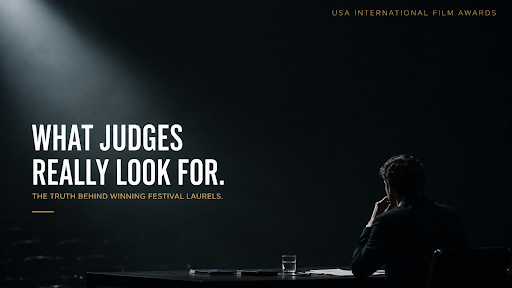
Every filmmaker has imagined the same moment.
Your film finishes. The lights come up. Somewhere behind closed doors, a jury begins discussing the winners. You picture a spreadsheet filled with scores, a few technical notes, perhaps a debate about cinematography or performances. Eventually, someone announces the result.
It’s a comforting image.
It also isn’t how memorable films usually win.
The conversations that shape festival decisions are rarely about whether a film is “good enough.” More often, they’re about whether a film refuses to leave the room after it ends. A juror remembers an image during lunch. Another keeps thinking about a character’s final decision while driving home. A third changes their opinion after hearing someone else explain why a seemingly simple scene carried unexpected emotional weight.
That is the part filmmakers almost never see.
And perhaps that’s the part worth understanding.
Judging is not a checklist. It’s a conversation.
Many filmmakers spend months trying to decode film festival judging criteria. They search for scoring rubrics, technical requirements, or secret formulas that might improve their chances of winning laurels.
Those things exist.
But they rarely tell the whole story.
Most international film festivals evaluate films across familiar categories such as storytelling, directing, acting, cinematography, editing, sound, originality, and overall artistic execution. Those categories help organize discussion, but they don’t replace it. Once every film has been watched, jurors begin comparing experiences rather than numbers.
A technically flawless film may receive consistently high scores yet disappear from conversation because it never surprised anyone.
Another film, perhaps made with a modest budget, might divide the room before gradually becoming everyone’s favorite because nobody can stop talking about it.
That’s why festival judging remains deeply human.
Numbers begin the discussion.
They almost never finish it.
The odds are challenging, but they aren’t discouraging.
Independent filmmakers sometimes wonder whether they’re competing against impossible odds.
The reality is demanding, not hopeless.
Research based on filmmaker submissions found that the average short film is submitted to nearly 200 festivals during its festival journey. Even with that level of persistence, the average festival acceptance rate sits at approximately 13 percent, meaning roughly one out of every seven submissions receives an official selection.
The picture becomes even more competitive at the highest level.
Only 1.54 percent of submissions in that research reached Academy Award qualifying or FIAPF-accredited festivals, or about one selection for every sixty-five submissions.
Those statistics shouldn’t convince filmmakers to submit less.
They should encourage filmmakers to submit more strategically.
A thoughtful festival strategy often produces better results than simply entering every festival with an open call for entries.
Does a bigger budget improve your chances?
Common sense says yes.
Festival history suggests the answer is more complicated.
Larger budgets usually provide advantages that are impossible to ignore. Better production sound, additional shooting days, stronger visual effects, experienced crew members, and more time in post-production all contribute to a polished final film.
Yet the same submission research uncovered an unexpected pattern.
Films with budgets between approximately $5,000 and $10,000 appeared to perform particularly well at prestigious international festivals. Spending significantly beyond that point did not consistently increase success at the highest-tier festivals, although higher-budget productions continued to perform well across broader regional and mid-sized festival circuits.
That doesn’t mean money doesn’t matter.
It means there comes a point where another dollar contributes less than another creative decision.
Judges notice intentional storytelling long before they calculate production costs.
The shortest films sometimes carry the greatest weight.
One of the more surprising findings from festival research concerns runtime.
Very short films, particularly those under five minutes, often achieved stronger acceptance rates than many longer shorts.
The reason has little to do with attention spans.
Programming a festival is an exercise in balance.
A ninety-minute screening block can include four twenty-minute films or nearly twenty five-minute shorts. Every additional minute your film occupies must justify the opportunity cost of excluding another filmmaker.
This doesn’t mean you should cut your film simply to make it shorter.
It means every minute should earn its place.
Festival programmers notice economy.
Audiences do too.
Genre influences programming more than quality.
Filmmakers often ask which genre wins the most awards.
That’s the wrong question.
A better question is which festivals genuinely appreciate the kind of story you’ve made.
Research suggests documentaries and animation often receive strong recognition at prestigious international festivals, while genres such as science fiction may perform exceptionally well across many regional festivals. Comedy remains one of cinema’s most difficult balancing acts. Audiences love it. Jury rooms sometimes struggle to agree on it.
None of these trends should dictate what you create.
They should influence where you submit.
The strongest festival strategy begins with compatibility, not probability.
What separates memorable films from merely impressive ones?
After enough screenings, technical excellence begins to blur together.
Beautiful cinematography becomes expected.
Professional sound becomes invisible.
Clean editing becomes the minimum standard rather than the achievement.
What remains memorable are the creative risks.
A film that trusts silence.
An ending that refuses easy explanation.
A performance restrained enough to invite the audience into the character’s inner life rather than announcing every emotion.
These aren’t technical accomplishments.
They’re artistic choices.
Festival juries often reward courage because courage creates discussion.
And discussion is where awards are decided.
What the USA International Film Awards values
Every festival gradually develops its own identity.
At the USA International Film Awards, films are evaluated through the craft of storytelling as much as the craft of filmmaking. Direction, performances, cinematography, editing, sound, originality, emotional impact, and technical execution all matter because they contribute to a larger question.
Does every creative decision serve the same artistic vision?
We’ve seen modest independent productions outperform films with considerably larger budgets because every scene felt intentional. We’ve also seen technically accomplished projects lose momentum when exceptional craftsmanship lacked emotional purpose.
Awards aren’t given to the film with the most impressive individual element.
They’re given to films where every element works together.
There is no formula. There is only clarity.
Filmmakers sometimes search for insider tips that guarantee festival success.
There aren’t any.
Every jury is different.
Every festival has its own programming philosophy.
Every year introduces a new collection of films that changes the conversation.
What remains surprisingly consistent is something much simpler.
The strongest submissions know exactly what they want the audience to feel, and every creative decision supports that intention.
They don’t explain too much.
They don’t imitate trends.
They don’t mistake complexity for depth.
Most importantly, they don’t try to satisfy everyone.
That’s a frightening way to make a film.
It also happens to be how many unforgettable films are made.
So if you’re preparing your next submission, don’t ask only whether your cinematography is stronger than last year’s winners or whether your sound mix meets professional standards.
Ask the question that every jury quietly asks after the credits have finished rolling.
Will anyone still be talking about this film tomorrow?
Because that conversation, more often than not, is where festival laurels begin.


