
 Back to Blog

The distance between Lilly and Carl is already doing dramatic work before their history has to explain it. In the supplied still, Lilly stands fully visible beside the lake while Carl occupies the opposite edge of the frame largely as a dark, partial figure. She looks toward him, but the composition does not grant them visual equality. There is landscape between and behind them, open air everywhere, yet the encounter feels constricted. For a film concerned with a daughter meeting her estranged father after her mother’s death, that imbalance is more revealing than a picturesque location ought to be.
Danny Szam’s British short Unforgiven begins from a difficult emotional proposition because Lilly is not simply grieving. She is carrying grief into a relationship that was already damaged. Her mother’s untimely death supplies the immediate wound; the meeting with Carl requires her to confront an older one. Those pains cannot easily be separated. Bereavement changes the meaning of estrangement because death has removed one part of the family while forcing another back into view.
That distinction gives the premise its dramatic pressure. Lilly is not approaching Carl as though reconciliation were automatically desirable. She is seeking something closer to resolution, and resolution is a much less comforting idea. Forgiveness may happen. It may not. Closure itself may prove impossible. The title Unforgiven wisely places that uncertainty over the encounter before the audience can reduce the story to the mechanics of a reunion.
Nekoda Garrett’s presence in the available imagery begins to clarify why the film’s performance dimension matters. In the lakeside frame, her face is not arranged into an obvious display of grief. The mouth is held almost neutral; the eyes remain directed toward the person opposite her; the shoulders do not collapse into an illustrative posture of suffering. What reads instead is attention under pressure. Lilly appears to be assessing Carl while simultaneously containing whatever the encounter is doing to her.
That containment is important. Grief performed at maximum visible intensity would give the audience an immediate emotional instruction. Garrett’s stillness permits something more complicated: Lilly can be bereaved, angry, apprehensive and searching without requiring her face to announce those states one at a time. The performance evidence available here is limited to still imagery, so it would be irresponsible to invent vocal rhythms, reaction timings or behavioral details that cannot be observed. What the frame does establish is an actor comfortable allowing tension to exist without decorating it.
Her August 2026 Royal Feather Award for Best Actress at the USA International Film Awards therefore belongs naturally in a discussion of the film’s acting rather than as an ornamental accolade attached to its title. Festival recognition does not prove a performance’s quality by itself; the interesting question is what the performance is being asked to carry. In Unforgiven, Lilly is the point through which bereavement and estrangement collide. Garrett has to make the meeting matter not merely because Carl is her father, but because the death of her mother has altered what this unresolved relationship now costs her. The award recognizes a performance positioned at the emotional center of that collision.
The supplied image offers another useful detail. Lilly carries a dark blue bag in front of her body. It would be excessive to turn an ordinary object into a predetermined symbol without further evidence, but its physical placement matters compositionally: her hands and the object occupy the space directly before her torso while she faces Carl. Whether incidental or narratively significant, the resulting posture is neither completely open nor overtly defensive. It gives the encounter an everyday physical awkwardness. This does not look like two characters conveniently arranged for a climactic confrontation; it looks like somebody who has arrived somewhere and now has to remain there.
The landscape makes that awkwardness sharper. A lake and green countryside might ordinarily invite visual release. Here, the natural openness surrounds two people whose shared history appears anything but open. Carl’s partial presence on the left is particularly effective in the supplied frame because the composition makes Lilly available to our scrutiny while withholding much of him. We read the encounter through the daughter who has chosen to face it.
That makes the film’s character-driven scale appropriate to its subject. Unforgiven does not need an elaborate external plot to manufacture stakes when the central action meeting an estranged parent after the other parent has died already changes meaning according to every withheld answer. What happened before? What does Lilly want from Carl now? What could he possibly say that would alter what has already occurred? Most importantly, is she there to recover a relationship or to discover whether she can finally live without one?
Those questions are more interesting than a predetermined promise of reconciliation.
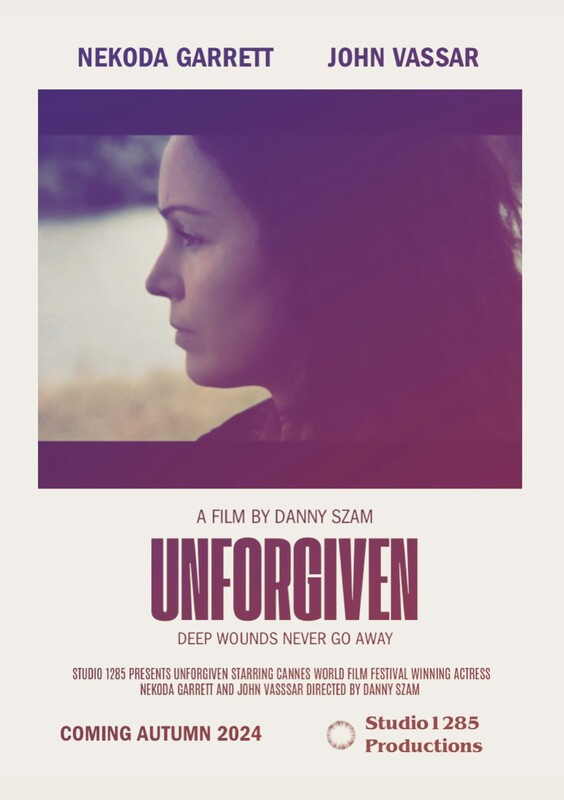
The poster’s line, “Deep wounds never go away,” initially sounds absolute. The premise makes it more complicated. A wound’s persistence does not necessarily mean that a person remains unchanged around it. Grief can remain while its place in a life changes; anger can survive without continuing to govern every decision; contact with an estranged parent can matter even when it does not repair the relationship. The title and tagline together establish a harsher possibility than the conventional healing narrative: some encounters are valuable not because they restore what was lost, but because they reveal what can no longer be restored.
Szam’s choice of a father-daughter confrontation makes this especially demanding of performance. Exposition alone cannot carry years of estrangement. If every injury must be verbally explained, the past becomes information. What matters dramatically is whether history appears to exist between the characters before it is articulated in the difficulty of looking, responding, approaching, withdrawing or simply occupying the same space. The available still provides evidence of that spatial tension, though a complete assessment of how consistently the finished film sustains it would require the moving work itself.
That evidentiary boundary matters. From the materials supplied, it would be unjustified to pronounce upon the editing, score, dialogue delivery or the complete trajectory of Garrett and John Vassar’s performances. Nor should a serious review invent a weakness merely to create the appearance of critical neutrality. What can be examined is what these materials genuinely expose: a film organized around grief complicated by estrangement; a visual relationship that places Lilly under greater scrutiny than Carl; and a lead performance whose visible restraint suits a character arriving at a meeting already burdened by emotional history.
The Best Actress Royal Feather Award consequently has a particular relevance. Garrett is not being celebrated here simply for portraying sadness. Lilly’s dramatic problem is harder than sadness. She has to stand in front of somebody who belongs simultaneously to her family and to the rupture within it.
Perhaps that is the most promising thing about Unforgiven: its central meeting does not appear designed merely to answer whether Lilly can forgive Carl. The title has already made forgiveness suspiciously easy as an endpoint. The deeper question is what Lilly will do with whatever remains when the meeting is over.
Her mother cannot return. Her history with her father cannot be unwritten. Whatever passes between Lilly and Carl therefore has to operate inside those irreversible facts.
And Garrett’s Lilly, standing across that small but stubborn distance from him, gives Unforgiven its most consequential image: not a woman waiting for the past to heal, but one who has finally chosen to face the person still standing inside it.


