
 Back to Blog

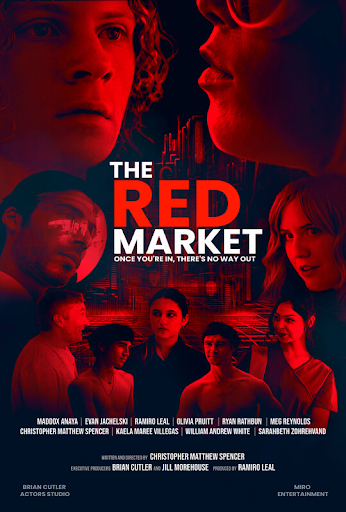
Some films invent frightening futures. Others quietly suggest that the future has already arrived—we simply haven’t agreed to call it that yet.
Christopher Matthew Spencer’s The Red Market, winner of Best USA Short Film and Best Debut Director – Short Film at the USA International Film Awards, belongs to the second category. It disguises itself as speculative science fiction, but beneath its imagined Global Organ Donor Exchange lies an uncomfortable observation about contemporary life: markets have become remarkably efficient at assigning prices. The only remaining question is what still escapes valuation.
Spencer never speaks about his film as a provocation for its own sake. Throughout our conversation, he repeatedly returned to a different word.
Dignity.
“Zephyr’s financial desperation is the doorway into the story,” he says, “but the deeper horror is what happens when a person begins to see his own body as the only asset he has left.”
That distinction changes everything.
Many thrillers ask how far a person will go to survive. The Red Market asks something more unsettling: what happens when survival itself becomes a marketplace.
Zephyr Sage, drowning beneath impossible debt, doesn’t enter Spencer’s fictional exchange because he is reckless. He enters because every other exit has disappeared. Spencer deliberately refuses to frame him as someone deserving judgment.
“I did not want Zephyr to feel foolish or careless,” he explains. “I wanted him to feel cornered.”
It is a subtle directorial decision with significant consequences. Instead of constructing suspense around whether Zephyr will make the “right” decision, Spencer positions the audience inside the narrowing corridor of his choices. Empathy becomes the source of tension. The horror is not watching someone make a mistake. It is recognizing how easily circumstance can make unimaginable decisions appear rational.
The speculative world of The Red Market never relies on futuristic spectacle to persuade us. Its technology feels plausible precisely because Spencer keeps pointing back toward the present.
“It is speculative fiction,” he says, “but it is rooted in real fears about debt, exploitation, technology, and the way modern systems can turn human need into commerce.”
That sentence quietly reveals the film’s true ambition. The fictional exchange exists less as world-building than as a mirror. Remove one technological innovation, and the emotional architecture already exists around us.
Perhaps the film’s most intriguing antagonist reflects the same philosophy.
Hyacinth, the loan shark who gradually tightens psychological control over Zephyr, rarely announces herself through violence. Spencer was far more interested in authority that whispers than authority that shouts.
“True menace does not always need to be loud,” he observes. “Sometimes it is calm, charming, and precise.”
That understanding of fear runs throughout the film. Even Spencer’s experience working in horror—including his appearance in Malum—doesn’t translate into graphic spectacle.
“The unease comes from dread, pressure, and moral discomfort rather than traditional scares.”
There is an unusual confidence in that restraint. The Red Market understands that audiences often imagine consequences more vividly than filmmakers can depict them.
The conversation repeatedly drifted away from cinema and toward something almost philosophical.
Debt, Spencer insists, is never merely arithmetic.
“Debt can become emotional, psychological, and even spiritual when it makes a person feel trapped or disposable.”
That may be the film’s most enduring insight. Modern storytelling frequently treats financial struggle as a logistical obstacle—a problem to solve before the third act. Spencer instead explores debt as an invisible force capable of altering identity itself.
“Zephyr is not simply trying to pay what he owes,” he says. “He is fighting not to lose himself.”
It is difficult not to hear echoes of countless contemporary anxieties inside that observation, even without the film ever naming them directly.
There is another paradox surrounding The Red Market. Although the story imagines an expansive dystopian system, the production itself emerged from circumstances almost entirely opposite to industrial filmmaking.
Spencer financed his directorial debut himself, assembling a volunteer cast and crew while navigating the realities of independent production.
“The entire project was shaped by constraint,” he recalls. “Instead of trying to make the film bigger in a conventional way, we leaned into atmosphere, performance, sound, visual effects, and the strange moral world of the story.”
Constraint, rather than limiting imagination, appears to have concentrated it.
His previous careers—in the U.S. Navy, business, acting, and commercial directing—also surface unexpectedly in the way he describes filmmaking. Leadership, for Spencer, is notably absent of mythology.
“Leadership is not about ego,” he says simply. “It is about serving the project and helping talented people do their best work.”
That sentence may explain the film as much as any discussion of style or genre.
Toward the end of our conversation, Spencer offered what sounded less like a filmmaker explaining a movie than someone defining a personal conviction.
“People often talk about morality as if it exists in a vacuum,” he reflects. “But pressure changes people. Fear changes people. Debt changes people.”
Perhaps that is why The Red Market lingers after its final frame. It never insists that audiences agree with Zephyr’s decisions. Instead, it quietly dismantles the comforting illusion that we always know what we would do under unbearable pressure.
When asked what emotional truth he hopes survives beyond the credits, Spencer doesn’t mention suspense, genre, or even cinema.
“Human beings should never be reduced to what can be bought, sold, or extracted from them.”
The line lands with unusual force because the film has already spent its running time showing how easily societies begin making exactly that calculation.
In the end, The Red Market isn’t warning us about a distant dystopia.
It is asking whether markets always begin with transactions—or whether they begin the moment we forget that dignity was never supposed to have a price.


